
How Novak Djokovic trains his mental skills
If we look through tennis lore, writing and commentary abound regarding Novak Djokovic’s famed mental toughness. Regardless of what you think about Djokovic, even the most ardent hater begrudgingly admits that, “Yes, okay, I don’t really like the guy… but I have to admit that he’s mentally tough.”
But here’s my argument: in the sporting culture, what most people call “mental toughness*” is actually the skill of accepting and letting go of immense frustrations and negative emotions, and then redirecting attention under pressure. And Djokovic is the best example of this on the ATP Tour.
My experience in the tennis and sporting world is that “mental toughness” is thrown around carelessly. It’s poorly defined by the general sporting population, and because of a simplistic or incorrect misunderstanding of what it entails, there’s lots of confusion in the general tennis and athletic culture regarding what it is exactly.
Tennis players beat themselves up for not being mentally tough enough. “You piece of shit! Why aren’t you more mentally tough? Like Djokovic is!”
Coaches and parents yell platitudes at players about being tougher and “fighting more” and showing more, “heart.”
But what does that all mean?
How is a player supposed to implement that?
So if Djokovic isn’t just “mentally tougher” than everyone else, what exactly is he doing differently?
I would argue that one of his greatest skills is his ability to notice frustration, fear, and self-doubt without becoming consumed by them. Rather than fighting those experiences or wishing they were not there, he accepts that they’re part of competing at the highest level and repeatedly redirects his attention back to what matters most.
That ability to regulate his attention is, in my opinion, one of the most important psychological skills in tennis. And like every other skill in our sport, it isn’t something you’re born with. It’s something you can train and build.
But before I explain how, I want you to hear it from Djokovic himself.
From the horse's mouth
Here is an excerpt from Djokovic’s 2013 book, Serve to Win. I know it’s quite a block of text, but I implore you to read it because I think it will illuminate some ideas for you. Djokovic explains mindfulness in a way I wish every athlete could read; simple, practical, and completely free from the spiritual clichés that confuse so many people.
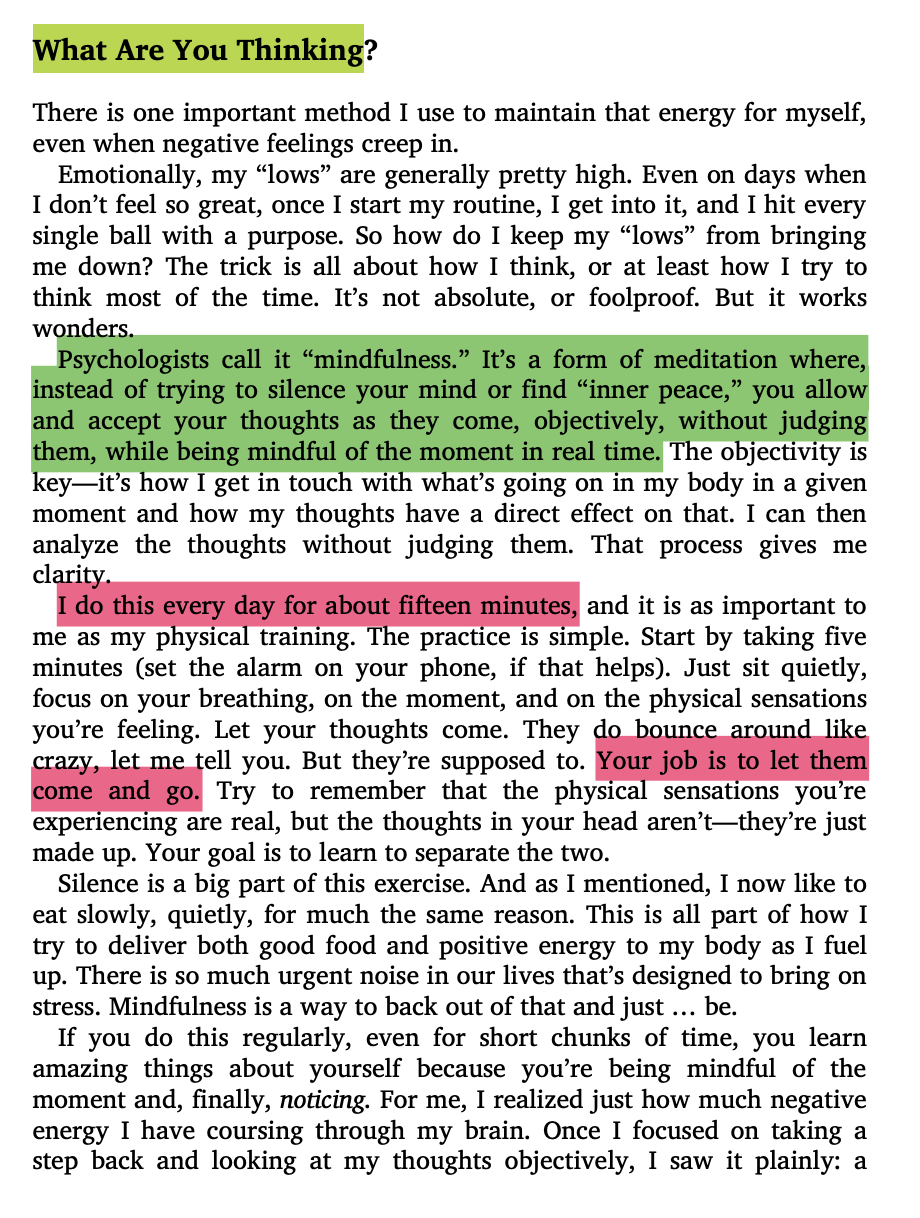
Hopefully a few concepts are clicking for you, but the first I want to start with is acceptance and non-judgment. I think, and I’m curious to hear your thoughts, that when it comes to the sporting world, there is a lot of macho-ness still out there.
Athletes want to feel, “mentally tough.” They want to feel, “Invincible,” and “unbreakable.” That problem is, unless you’re somewhat sociopathic or riding the highest high of your life, more than likely you’re going to struggle to feel this way consistently. More than likely, you’ll have doubts. You’ll have worries. You’ll have concerns.
And often, when we have these fears, we can amplify them further by not wanting to experience them.
“Why am I feeling this way?”
“I don’t want to be nervous.”
“I want to feel brave.”
“I want to feel ready to compete.”
Note how Djokovic writes about letting these thoughts come and go. Why does this strategy work? Because it reduces the secondary struggle of "notwanting to feel this way.” It stops the spiraling by reducing your negative reactions to your experience.
In fact, in one of the mindfulness tangential classes that I teach, the biggest misconception that I have to address with mindfulness is that it’s not about “clearing your mind,” “emptying your mind” or “finding peace and relaxation.” Rather, it’s about nonjudgemental awareness of our internal and external landscapes. And that also means an acceptance of the constant barrage of negative or critical thoughts that we might face during competition.
There’s a famous interview which I’ve covered in the past where Djokovic says—and here I’m paraphrasing—that it’s not normal to expect yourself to feel invincible in the toughest moments. You’re a human being. It’s only that he’s found a way to spend less time in those thoughts and emotions and feelings… and he’s able to redirect his attention more quickly to task-relevant thoughts.
Let me ask you this:
When it’s 3–4 30–40 in the 3rd set and you’re serving to not get broken, what do you want to be occupying your mind? Thoughts and concerns about potentially going down a break, losing, the effects of that loss on your social reputation or ranking? Or do you want to direct your attention toward task-relevant cues and ideas… following your routines, regulating your anxiety, planning out your serve and placing your following shot into the open court so that you can force an error? I think the answer is obvious to you.
That difference—between future-oriented worries and present-oriented focus—is the difference between a poor performance and a quality showing.
Don’t believe me? That’s fine. I just research mindfulness-based interventions in professionals tennis players. But you don’t have to take my word for it. Take Djokovic’s:
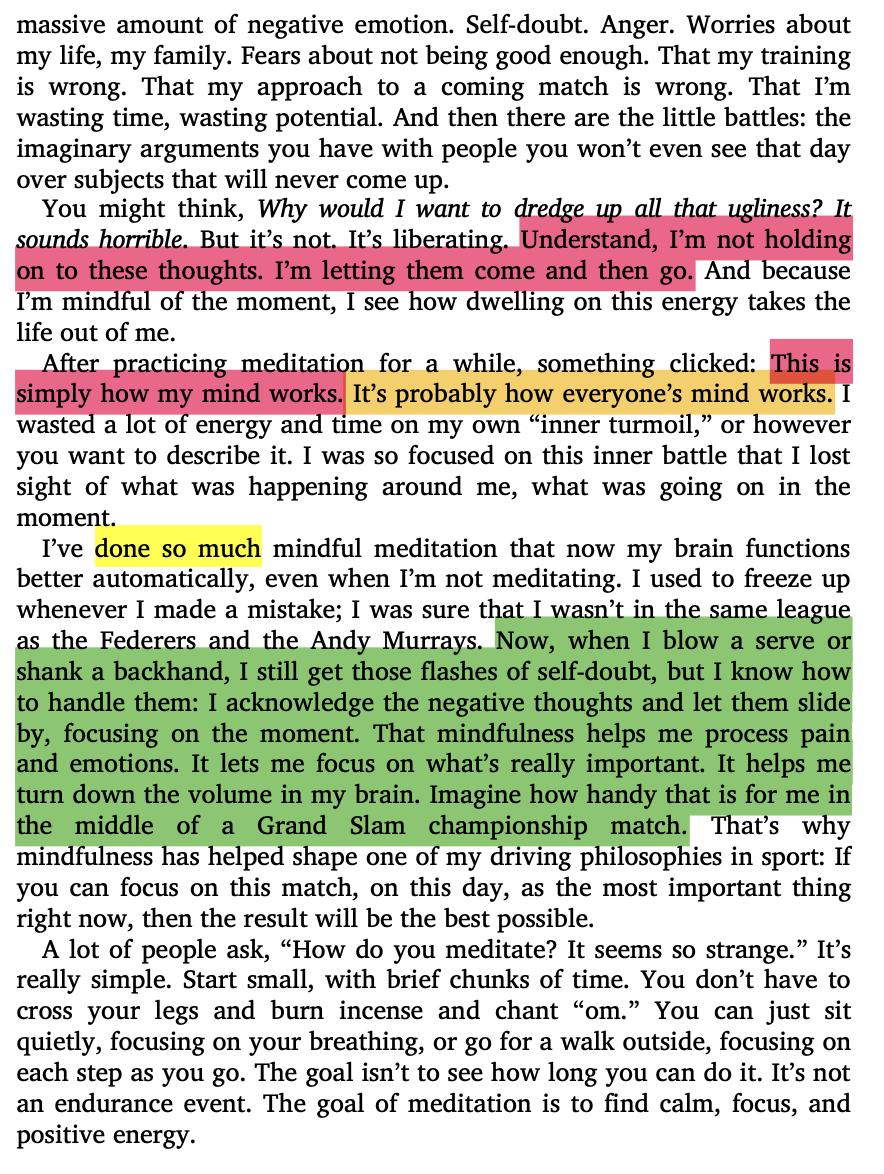
Note how Djokovic doesn’t embody the traditional, macho-man idea of mental toughness, where an athlete will never face mental challenges, negative thoughts, worries, and concerns. Rather, through his mindfulness practice, he understands that negative thoughts and self-doubt are a normal function of being a human being. He writes, “That’s why mindfulness has helped shape one of my driving philosophies in sport: If you can focus on this match, on this day, as the most important thing right now, then the result will be the best possible.” Put another way, Djokovic is able to modulate his relationship to his fears and anxiety and turn his attention back towards what matters most in the moment. In other words, he works every day to train his attentional control.
So once again I ask you… how do you train your attention?
Could you get stronger without resistance training?
Here, now, we get to the crux of the matter. I once spoke with a high-level junior player whose parents informed me that she had been working with a mental coach for about 10 sessions or more. This coach, had simply been telling her to be, “present.”
“Be more present.”
“Be more present.”
But that’s like telling someone “be strong” without getting them to do any resistance training.
Would your bench press improve if you didn’t train?
What about your squat? If you didn’t load up that bar would you be able to move more weight?
What about pull-ups?
I think you get the idea; if you wouldn’t be able to improve your physical strength without training, why would your attentional control skills improve without practice?
Again, from Djokovic, “I do this every day for about 15 minutes, and it is as important to me as my physical training.” Here’s another way of thinking about it: you have to practice consistently to improve your mental skills. In this case, attentional control.
Just like your strength doesn’t grow without progressive overload, your attentional (and mental skills) won’t grow without deliberate and consistent practice. Hoping that when the rubber hits the road that you’ll be “more present” is not a mental training plan.
Start your own mindfulness practice
There are 3 main steps in starting your own mindfulness for performance practice. The first is to actually understand the concept of mindfulness and what it means. Think about what we've covered so far: hopefully you've understood that mindfulness is not about "emptying your mind," or "making it clear." These things are impossible unless you're brain dead. It's rather about changing your relationship to your thoughts and how latched onto them you are.
Second, you must consistently practice. When working with my 1:1 clients, I suggest a baseline of 12-minutes per day, at least 5x a week. Yes. I know that is quite a lot. It's a dedication and a commitment, which is why many athletes falter. But it's the same with any skill you've trained in your life. We are doing athletic "push ups" every time we train our attention to come back to the task at hand (stealing terminology from Amishi Jha). Consistent practice is a requisite to actually becoming more mindful.
And finally, you must learn to blur the boundaries between formal mindfulness practice and your competitive life. The goal is not that you just do your 12 minutes of mindfulness and then forget about it for the remainder of the day. No, start blurring the boundaries between formal practice, and how you are in the lead up to matches, during matches, and even afterward. This is what I take my clients through.
Your takeaway
"Mental toughness" is not an ingrained personality trait. It’s actually a trainable skill. Djokovic isn’t “fearless” in the traditional, macho-man sense of mental toughness. He’s just trained his attentional control skills so deeply that he doesn’t let fear, frustration, and self-doubt control his behaviors. If you can learn to notice your thoughts, change your relationship with them, and bring your attention back to your task, you will play steadier, recover faster from hiccups, and compete closer and closer to your true potential.
*Mental toughness is a distinct concept in the sport and performance psychology literature. There is healthy debate and discussion about how it is defined. In this this piece, when I refer to it, I’m referring to sporting culture definition of mental toughness—not the sport and performance psychology construct.