
Why you need to understand working memory
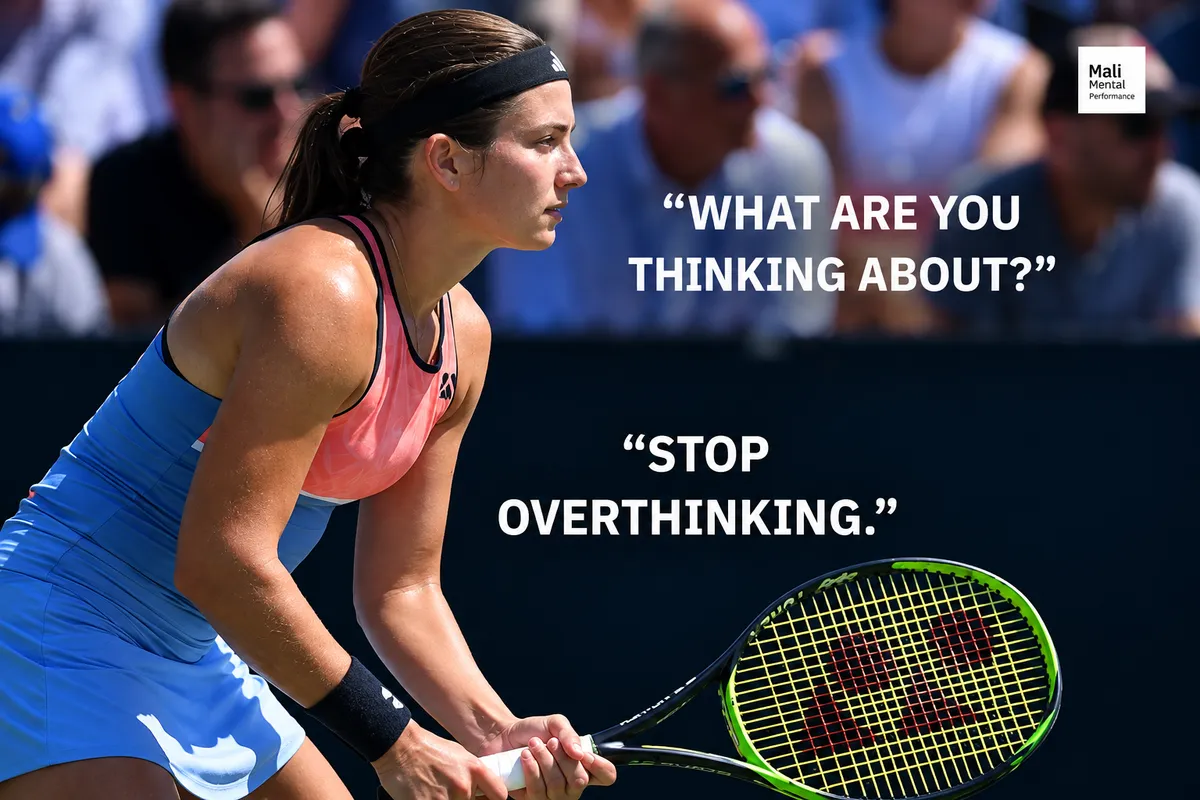
What do you think about when you’re playing tennis?
I mean during the actual point in a tournament.
What’s preoccupying the bandwidth of your brain?
Are you focusing on step-by-step, technical instructions that your coach gave you?
Make sure you do the unit turn by the time the ball crosses the net, then you separate your hands, and then my hand has to take the racket head high-low-high, but I also have to make sure to get the racket head nice and low. And, oh yeah, let me finish nice and high as well.
Or is your brain taking you to the future? Worries about the outcome? Winning and losing?
If I win this break point now, then I just have to serve it out and the first set will be mine.
Or, perhaps:
I have to win this match. I have to win this match. I have to win this match.
Let me stop you right here.
And introduce to you a concept that I hope will be quite instructive and helpful.
Welcome to working memory
Think of working memory as your brain’s mental bandwidth or even a “whiteboard.” It’s the limited space where we humans hold and use information to perform tasks—like playing tennis points.
It’s not where long-term skills live or where automatic habits or reactions live. It’s more like a notepad or scratchpad that our brain uses in the moment to keep track of what’s important right now.
But here’s the thing. That space is pretty limited. Tiny, even.
Researchers have discussed how working memory can hold only a few chunks of information at a time (Furley & Memmert, 2010). Now when you’re completely “locked in” and focused, your attention is directed toward things that help you perform and execute. Things like tracking the ball, reading your opponent’s racket face, executing patterns, etc.
But when you’re threat-focused—caught up in negative thoughts, internal tension, or worrying about the outcome and unable to stay present—your limited working memory capacity can get hijacked and overrun. These intrusive thoughts, or even somatic experiences that you over-identify with, start competing for your brain’s resources.
This is also a reason why I don’t advocate focusing on heavy technical and internal cues when trying to play competitive tennis. I assume a lot of tennis coaches would be unhappy about that recommendation. But keep in mind the information that we’ve covered so far: working memory capacity is limited at particular moments in time. Do you want to devote your limited whiteboard space to heavy technical cues, or to more useful ones like ball tracking?
Now, the really interesting part to keep track of is that stress and anxiety can make it harder to use working memory effectively. Put another way, during times of competition or anxiety, our whiteboard can feel as if it “shrinks” a little bit.
What to do… what to do?
So, if you’re constantly finding your attention hijacked by negative thoughts, anxiety, worries about winning or losing, or somatic tension, you might feel that hope is lost.
Fear not, though, dear reader, because it is not. This is where applied sport psychology comes in. We have several ways of helping you direct your attention back to where it needs to be.
Approach #1: Cognitive behavioral
Our fears and emotional reactions regarding matches; fears of needing to win, thinking that wins and losses define us, and our general beliefs about competition and being judged can be some of the drivers of anxiety and stress when performing.
You appraise a situation as “threatening” in some way. Maybe you perceive losing a tennis match as catastrophic to your self-worth, scholarship hopes, or your identity or reputation in your social circles.
Your thoughts start to race, your heart rate spikes, breathing quickens, and your body prepares for survival. Not playing… tennis.
Now think about it through the lens of working memory. These symptoms, sweaty palms, tightness, and racing thoughts, start crowding your limited working memory. Your personal whiteboard is now filled with fear-based reactions and thoughts instead of performance-relevant cues.
Cognitive-behavioral tools help to address this cycle in numerous ways.
The first step is by bringing these distorted thoughts to light. Thoughts like, “If I lose, I’m a failure,” or “Winning and losing a tennis match is a direct measure of my worth.”
The second step is by challenging their logic rationally and dispassionately. A practitioner will often use Socratic questioning in this step. “Let’s break down this belief; is it actually true?” “How do you think believing this is impacting your performance?”
And the final step is to develop more flexible thoughts and interpretations of events. “The results of tennis matches don’t define me… I have a loving family and a beautiful life to be thankful for,” or “I’m defined by many other things than just winning tennis matches.” The trick, here, if there is one, is that belief change is often experiential. A skilled practitioner will take you through the appropriate methods to encourage this more flexible approach.
This process is called cognitive restructuring. It’s one of the methods that applied sport psychology draws from psychology to help athletes manage cognitive anxiety and use their attention appropriately.
Approach #2: Mindfulness-based approaches
Some players scratch their heads when I mention that mindfulness concepts can help athletes with their tennis. I can imagine that statement is often a head scratcher.
But think about all the information that we’ve covered so far:
First is that working memory is limited—and it gets overloaded by outcome-based thoughts, technical monitoring, or performance anxiety.
Next, stress can leave less of that bandwidth available, making it harder to focus on the ball, tactics, or your opponent’s strikes.
And because of all of this, your attentional system can get hijacked by worries, self-judgments, or other internal or external distractions.
This is where mindfulness-based training can help. Mindfulness teaches us how to notice distractions without getting thrown off course by them. Most importantly, it encourages us to redirect our attention back to the present moment, again and again.
It’s not a skill about being “zen.” The way I explain it to players is that it’s about attentional control and about being able to consistently redirect your attention to the task at hand.
A sport psychology professional will ask you to translate this attentional control skill onto on-court cues and points of focus—such as directing your attention to ball tracking.
Mindfulness is not some magic cure that fixes performance ailments. It helps you to respond to what you’re experiencing—even when the chips are stacked against you. Over time, the aim is better emotional regulation and less reactive behavior. More attention available for what matters most: playing the best point possible now.
Your takeaway
Your working memory is your brain’s whiteboard. And in high-pressure and stressful moments, that bandwidth is easily maxed out. Whether it’s crowded by fear, technical micromanagement, or anxious predictions about what will happen next, what you fill that space with matters.
In my opinion, the goal of applied sport psychology is simple: help you protect and use that space your best, so that you can focus on what helps you play your best.
Reference
Furley, P., & Memmert, D. (2010). The role of working memory in sport. International Review of Sport and Exercise Psychology, 3(2), 171–194. https://doi.org/10.1080/1750984X.2010.526238