
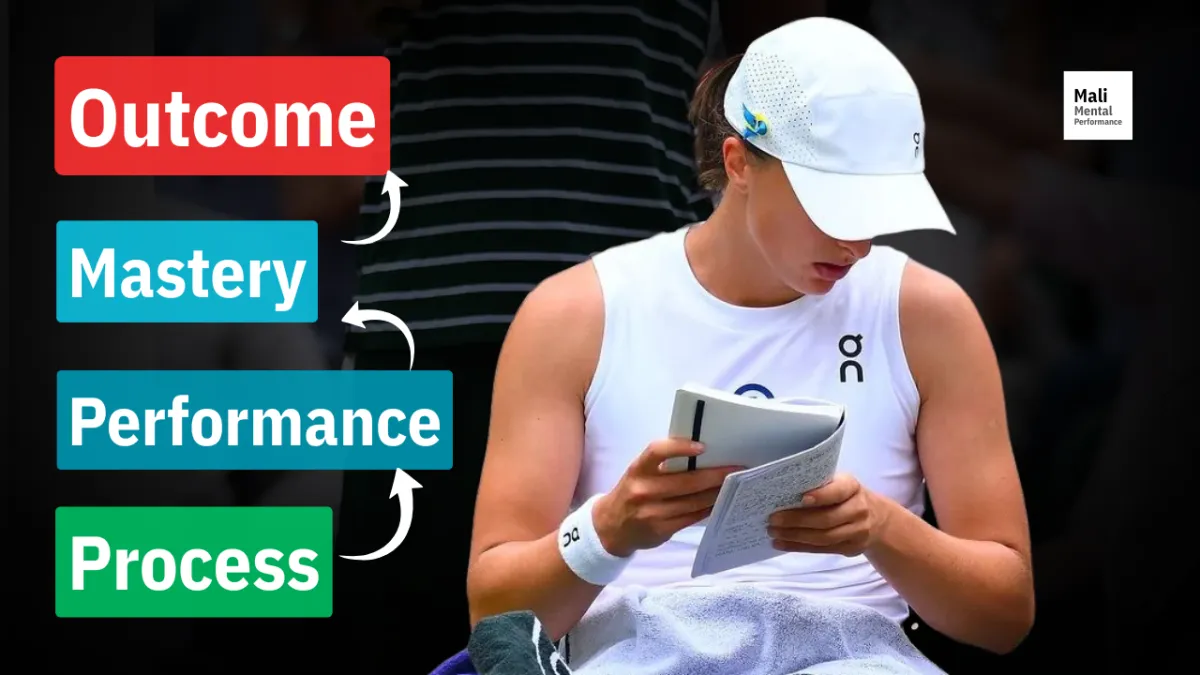
How tennis players should actually set goals
I work with tennis players around the world and a common theme seems to be that you want to win more and improve your ranking and rating.
That’s great.
I mean, who doesn’t want to win and improve your ranking and rating?
But that idea of winning and improving your ranking more is often mentioned without much thought or care.
Worse, winning and improving are often described in ways that don't really make sense.
“I want to finally get to a 4.5 NTRP.”
“I want my son to be a 11.0 UTR.”
"I want to get my first WTA points."
These are the kind of statements that I often hear.
My follow-up question is usually how?
How are you going to improve?
And what do you need to address in your game in order to improve?
And it’s an important component to consider.
Because I’ll get back answers like, “Ummm, I need to win more,” or “I don’t know… I’ve been thinking I need to be more clutch in matches," or, "I just need to put it all together."
It’s a question that not only reveals the player’s ideas of what constitutes improvement to them but also highlights the difference between process and mastery goals versus outcome goals—types of goals that can mean the difference between real progress and anger and frustration.
What you need to know about goal setting
Let’s start with the problem at hand.
In tennis—and sports in general—setting goals is important.
But setting the wrong kind of goals can hold you back, maybe even set you up for failure.
When I talk about setting goals, players zone out. Their eyeballs roll back. I can almost hear them clicking away from this newsletter.
“Goal setting? Boring. Lame. This isn’t anything new or revolutionary.”
“Setting goals? How can that be helpful? Just help me improve my ranking already? Why am I paying you?" I can learn this off a YouTube video… is it even that important?”
I used to think this way, too, before I knew the impacts of implicit and explicit goals on player development and performance. And, in fact, goal setting is one of the most powerful interventions we teach in applied sport psychology.
So here’s the main issue: too many players set goals that are focused entirely on outcomes.
They say things like “I need to win more,” or “I want to be more clutch in matches.” (Whatever the hell that means.)
The problem? These outcome-focused goals are often vague, rely on external factors, and don’t offer a roadmap for improvement.
Outcome-focused goals emphasize results over progress. In other words, they make you feel successful only when you reach a specific, often ill-considered milestone. This type of goal setting creates pressure, and that pressure can lead to anxiety and decreased performance.
In sport psychology research, this is loosely defined as having an outcome orientation, and research shows that this focus can actually limit performance improvement over time. Researchers like Carol Dweck—yes, the Dweck who popularized the idea a Growth Mindset—and John Nicholls have studied how goal orientation impacts motivation and performance.
According to their research, and here I'm speaking generally, focusing on mastery-oriented goals—which are goals centered on improving skills rather than just winning—leads to higher levels of motivation, better resilience under pressure, and ultimately, greater success over time.
On the flip side, athletes who become overly focused on outcome goals often experience greater anxiety and fear of failure because success becomes defined externally through rankings, ratings, wins, and losses.
So, if your goal is purely something like, “I want to be a 4.5 player,” you may be standing in the way of your improvement and long-term enjoyment of the game.
The 4 types of goals in sport and performance psychology
Before we go on, it's worth understanding that not all goal types are made equal. And that the way we classify them in sport and performance psychology is important—along with what impacts they generally have on the athlete.
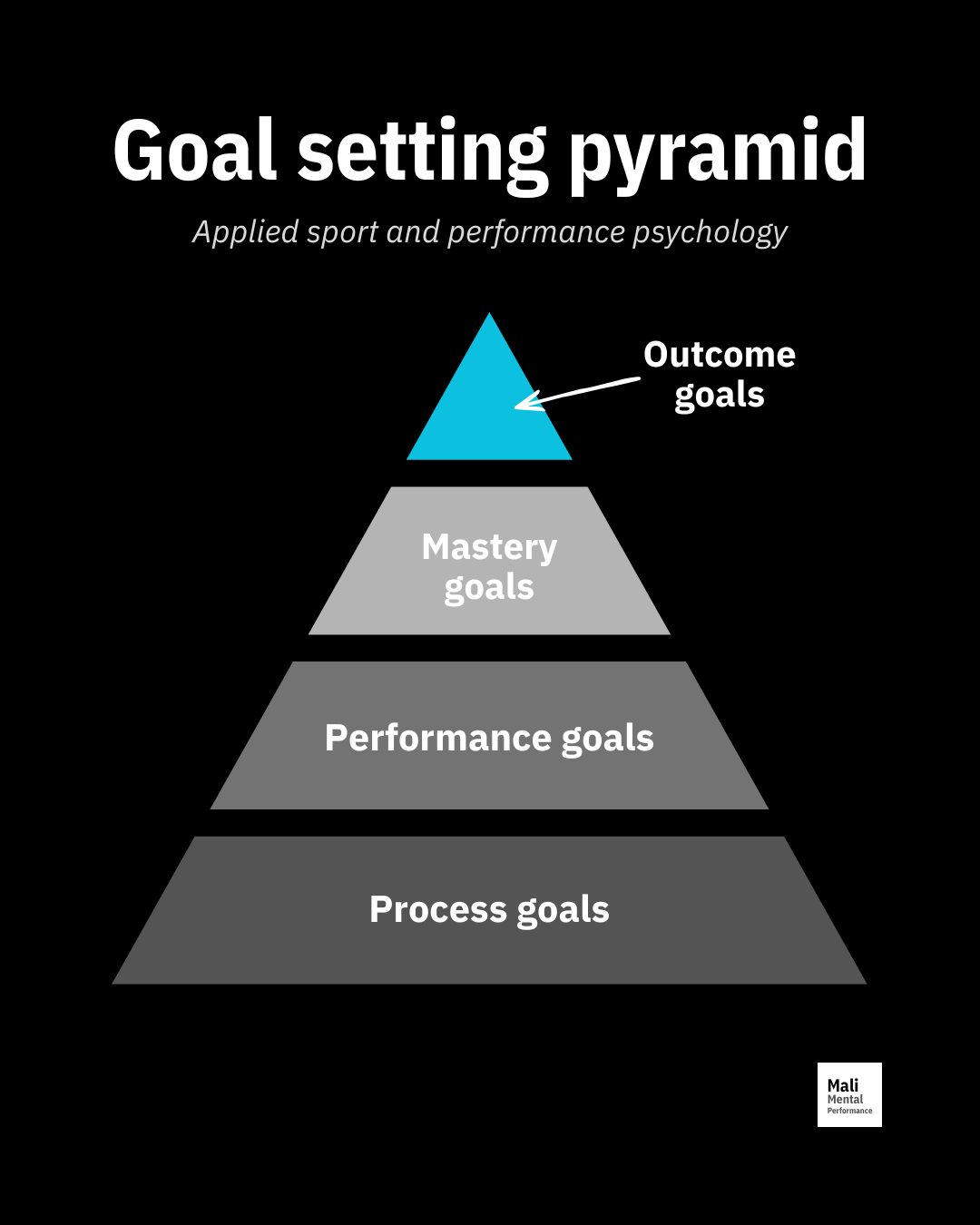
To make it all easier to understand and follow along with, I've made the above diagram for you. Notice how process goals are at the bottom and they feed into performance, mastery, and then finally outcome goals? It's important that you understand the shape of this pyramid and how goal-setting works in applied sport and performance psychology because you can use it as a powerful framework to accomplish your required outcomes. Let's understand them each properly with these definitions:
Outcome goals
Focused on results.
Example: reach a 1600 ATP, reach 7 UTR, etc.
General research findings: can provide motivation and direction, but an excessive focus on outcomes has been associated with higher performance anxiety, fear of failure, and lower long-term enjoyment of sport.
Performance goals
Focused on measurable standards and numbers.
Example: achieve a first-serve percentage to 65%, keep unforced errors below 10 during the match.
General research findings: can help direct attention toward measurable aspects of performance and provide useful feedback, though they are generally less effective than process goals for improving focus during competition.
Process goals
Focused on specific actions during your performances.
Example: use my between-points routine, attack every short ball, always target deep middle when I'm behind the baseline.
General research findings: the gold-standard for improving performance and well-being because they direct attention toward actionable and controllable factors, and the athlete measures themselves on those factors, as opposed to just, "Did I win or did I lose today?"
Mastery/task goals
Focused on long-term development and learning.
Example: make my movement and ball tracking world-class, turn my serve into a true weapon, learn to not give up the baseline and hold my position.
General research findings: can improve intrinsic motivation, can increase self-efficacy, long-term satisfaction, and connection to the sport.
The problem with your goal setting
What are your thoughts so far? Many athletes when exposed to this information start to realize that they're purely outcome-oriented.
When a player is solely outcome-focused, success is defined purely by a result. For example, they might believe something like, “If I’m able to reach ranking x, that will mean I’m a successful tennis player.”
While on the face this can seem like a harmless and common goal—(and, trust me, it’s extremely common)— this approach has a few significant issues:
Neglecting skill development: If you start excessively focusing on winning or achieving your outcome, you may start neglecting the key skills you need to develop that are required for you to achieve the playing level you dream of.
Anxiety and stress: Anxiety and stress also start to mount when you’re nowhere on track to achieve those goals after months of trying. If your only focus is on achieving a ranking or rating, you’re less likely to view your development holistically and understand what you need to work on to achieve the level you crave. Trust me, I’ve been there.
Burnout: constantly reaching for an outcome that you’ve made a big bet on without seeing immediate results can lead to burnout. If you’re not achieving that next level as quickly as you’d like, you can get frustrated, lose motivation to persevere and experience a lack of commitment. In other words, you’re going to burn out!
So, the question is, how do we shift focus from an unproductive goal type to one that actually drives sustained improvement?
A case study
Take, for example, a player I worked with.
He came to me because he wanted get his UTR rating to 12. He was around a high 10 when we began and was wanting to compete in ITFs. Other than having that as his desired outcome, he had no real roadmap for how he wanted to become that kind of player—other than the cursory: “I need to play better in matches, get better, and beat better-ranked players.”
His goal was simply outcome-based, without any specific actions or intentions behind it. Through a few sessions with me, we decided to take a different approach. Instead of focusing purely on the outcome, we built a goal hierarchy:
Outcome goal: Reach a 12 UTR and compete in ITFs.
Mastery goal: Become an aggressive all-court player capable of taking time away from opponents.
Performance goals: Improve serve effectiveness, increase number of net approaches, and become more effective finishing points at the net.
Process goals: Serve-and-volley on first serves, attack every short ball, and commit to aggressive court positioning.
Most tennis players spend 90% of their time thinking about the top of the pyramid and almost none of their time thinking about the bottom. The irony is that the bottom of the pyramid is what creates the top.
More specifically for this player, we:
We built out a “player identity” where he committed to being an all-court, aggressive player who attacked the net at every opportunity: As a result, with his coach, he set in place practice structures and drills under deliberate conditions that he could use with his practice partners. Through discussion, he realized that the style of tennis he wanted to develop was that of an aggressive all-court player rather than someone who stayed behind the baseline. This also increased his intrinsic motivation because for the first time in a long time, he felt like he was working on improving himself. He understood that his net coverage had to be better; that his serve had to improve; and that he needed to develop the skills to play in the ways that he wanted. All of a sudden, he was the one was getting up and doing the hard work to achieve those things.
We changed his focus toward process goals in his matches instead of fixating purely on his outcome: this player used to get stressed and anxious when he played matches because his focus was on what winning and losing meant in terms of his standing and reputation in his social circles where he played and trained and also in contrast to the goal he had set. As we’ve covered, this isn’t the healthiest way of approaching competition and improvement—and can actually work in your detriment when you’re trying to get the best performance out of yourself. I don’t recommend it. So we started to set small process goals that he could focus in on during matches. Things like: 1) I will serve and volley on every first serve, 2) every time the ball lands short, I will approach the net. I encouraged him to evaluate himself based on his execution of those goals, rather than whether he won or lost the match.
Match review: And finally, I encouraged him to review his performances objectively based upon the goals that we set. For example, if the above were his two process goals, how often did he actually execute them during a match? Was he brave enough to approach the net at 30–30 and 4–4? Or did he revert to being timid and scared because he desperately wanted to win the point?
Rather than focusing on whether he won or lost and riding an emotional roller coaster, he started to review his matches by asking, “Did I execute my process goals? Did I stick to my routines?” It was rewarding to see how this changed his approach to competition.
And within a few weeks of consistent feedback and work on all of this stuff, we started to see a shift in his approach to his tennis and consequently his performances. He wasn’t as obsessed with scores and had less issues with anxiety. The kicker was that he was actually playing better, which was what was gaining him his better results. And as his process goals and task goals led to better skills and performance, his outcomes changed.
He hasn’t reached a 12 UTR yet, but I’m certain that if he keeps going down this path and becomes better athletically, it’s a level that he can attain. More than that, he's now focused on developing the skills that will get him to the level he needs to be at. In other words, he stopped measuring himself by where he was and started measuring himself by who he was becoming.
If you’ve struggled to see results, despite wanting to improve your ranking of rating, it might be time to look at your goals themselves and how and what you’re practicing.
Are they outcome goals? If so, maybe it’s time for a shift.
It’s about creating a roadmap for your game, with accountability and a clear structure to help you reach your tennis goals.
To conclude...
Goal setting is one of the most powerful interventions in sport and performance psychology. You have to know the difference between outcome, performance, process, and mastery goals, and know how to use them to better help you with your performances. Outcome goals tell you where you want to go. Mastery goals tell you who you want to become. Performance goals help you measure progress. Process goals tell you what to focus on today.
And if you want personalized help with improving your mental performance, get in touch below.