
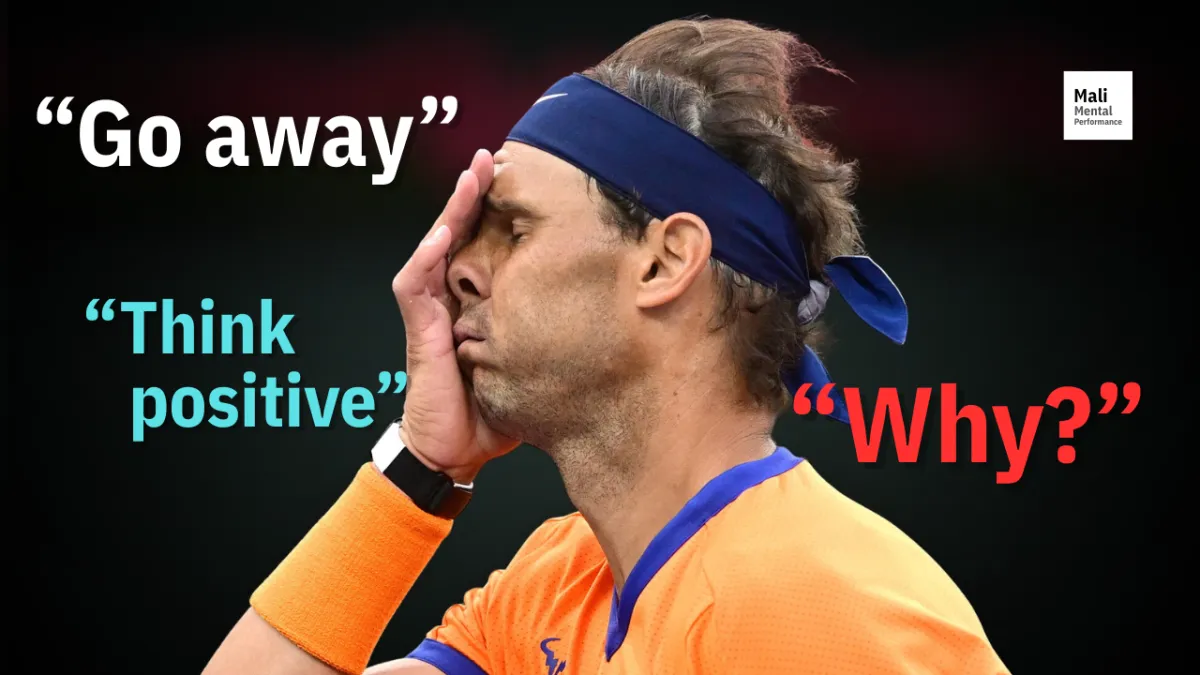
Overcome negative thoughts in matches
One of the most common questions I get from my clients is:
"Malhar, how do I deal with my negative thoughts when I'm on the tennis court? I feel like they take over and they stop me from playing my best tennis."
To answer this question, and the others which come up around it, we're going to address what may cause negative thoughts in performers and then take you through one way of dealing with them when they do arise. Let's begin.
What causes negative thoughts?
In the field of applied sport psychology, there are competing explanations for the creation of negative thoughts. Whether that's self-presentation concerns, ego-orientation, or something else.
One of the biggest mistakes tennis players make is believing that negative thoughts are completely random. They're definitely not. Most negative thoughts are your brain's attempts to deal with what it thinks might be a threat in your environment. Your brain is basically just trying to protect you.
Let's say you're about to play an opponent in a tournament or in a league match. Suddenly your mind starts producing thoughts like:
"What if I choke and lose this match really badly?"
"I should win this match but what if I lose? What will people think of me?"
"I've been training so much and what if I can't even put it all together on the match court today? I'm going to be devastated."
You may feel like your brain is actively trying to sabotage you. But from your brain's perspective, it's actually trying to protect you by preparing you for the worst-case scenarios of what might happen. Your brain may even be trying to get you to flee from the situation you're about to put yourself in.
One framework I use with my 1:1 clients is challenge vs. threat.
Put it simply: your brain is always asking one question when it comes to evaluative events in your life: "Do I have enough resources to deal with what's about to happen?"
If the answer is a yes, you can experience a challenge state of being. You care, sure, your heart rate increases, sure, and you still feel a little nervous. But your body can interpret those sensations as "I'm getting ready to compete."
A challenge state usually is associated with a lesser amount of negative thoughts.
But, if you view the upcoming match as a "threat" to you or your social status, your body can shift toward a "threat" state. The same physical sensations you experience in a challenge state... now feel dangerous. They are also more magnified.
"Oh man... why am I so tight in my body!"
"God my mind is bouncing off the walls."
It's like you can't even focus on the ball. You start holding muscular tension. And your thoughts become increasingly more intense and negative because your brain is desperately trying to solve problems and protect you.
An important note: it's not really the negative thoughts that are the problem. They're a symptom of your brain deciding that you're under threat... it's important to keep that in mind.
So how do we overcome negative thoughts before matches? We have two distinct ways to do so in applied sport and performance psychology.
Examining your thoughts (cognitive approach)
A more traditional approach used by psychology-trained sport psychology professionals is to encourage athletes to examine the content of their negative thoughts. If a player consistently thinks, “I always choke under pressure,” we’d ask questions like: Is that actually true? What’s the evidence for it? Out of 10 matches you played, is it true that you "always" choked in all of them? Are there examples where you handled pressure well?
The goal is not to get athletes to lie to themselves or pretend everything is perfect. It is to replace distorted or unhelpful thinking with more accurate and useful interpretations of events. One of the most common patterns I see with athletes who struggle and those who struggle with negative thoughts is black-and-white thinking (there are many other distortions, but for today we'll just stay on this one). It is when you see everything as absolutes, either good or bad, either black or white. It's also often referred to as all-or-nothing thinking. For example, if you've trained really hard for 5 weeks and if you lose second round in a tournament you thought you'd go far in, the negative thoughts might be: "It's all been useless! Why did I spend so much time training? Why did I spend so much money?"
But was it really all useless? Didn't you get fitter during those 5 weeks? Didn't you improve your skills? Didn't you progress in some way? Has it really all been useless? That's why I encourage clients to be aware when their thoughts and beliefs rely heavily on words like:
All
Always
Never
Every time
No one
Completely
You get the idea. You must become aware when you're engaging in black and white thinking because it can truly create thought spirals where you see the situation as being far worse or challenging than it actually is.
When I hear words like these with my clients, it’s often a signal for me to slow the athlete down and examine whether their interpretation is actually accurate.
For example, an athlete I work with recently told me:
“I always choke under pressure. I constantly mess it up.”
Really? Always? Out of 100 matches? Have you choked 100 times?
I've heard: “I feel like everyone is judging me.”
But is everyone watching your match? Or are most people thinking about their own? How do you know that everyone is judging you, by the way?"
“That tournament was a complete waste.”
Completely? Did you really gain nothing from the experience? Did you not learn that you have a pre-match anxiety problem?
Notice what we’re doing here with clients.
We’re not trying to force positive thinking. This is a common myth and cliché I deal with when I speaking to players, parents, and coaches. You think the fix is simple: "Just think positive." Unfortunately... it doesn't work that way.
We’re trying to identify when our mind has drifted away from reality and toward distorted conclusions. By slowing down and questioning those interpretations, we can often arrive at a perspective that’s more balanced, more accurate, and ultimately more helpful for performance.
How to apply this before, during, and after matches
Now you know about how our minds can have a tendency to distort our thinking. But that's not enough. You have to actually practice identifying distorted patterns of thinking in your interpretations.
Over the next week, I want you to notice when negative thoughts appear before, during, and after your matches. And then ask yourself:
Could I be assuming the worst-case scenario will happen?
Am I speaking in absolutes?
Is there actual/good evidence for what I’m thinking?
Is there another interpretation that’s just as possible?
Again... I want to be really specific here. We're not trying to get you to put on rose-colored glasses and assume that everything is wonderful and hunky dory. Rather, we're just trying to get you to understand that you're wearing a pair of glasses and the lenses that you see the world though could be what is creating the challenge itself.
We want you to move away from distorted interpretations of thoughts and events to ones that are more balanced and accurate. And like every other psychological skill, you must practice it for it to improve!
Important limitation
This cognitive approach has helped countless athletes over the past few decades. But it isn’t the only way of dealing with negative thoughts.
Some athletes find that constantly questioning or challenging every negative thought is just exhausting... and it can be draining... and it can place attention on yourself when you need to really be focusing on your performance. Other athletes have told me that it can feel like you're arguing with yourself for the entire match.
That's one of the reasons another family approaches has increasingly become more popular in applied sport and performance psychology. Rather than asking, "How do I change this thought to something that's more accurate and balanced," they ask, "What if I just need to change my relationship to this thought." And I'll cover that in a separate article... because it deserves its own discussion.
Your final takeaway
Negative thoughts are a normal part of being an athlete and performer, especially when something matters to you. But what matters more is whether you just accept every thought that your mind generates as "fact" or "truth."
Sometimes your mind is accurate. But sometimes it is not. Sometimes it catastrophizes. Sometimes it views events as all-or-nothing. And sometimes it's just trying to protect you from what it sees as a threat.
The first step with dealing with negative thoughts is not to just fill your head with "positive" ones. It's about being more curious. Learning to question your thoughts. Seeing them as if you're a scientist. Examine the evidence for them. Or against them. And learn to see when your mind is making conclusions which are not supported by reality
That’s a psychological skill.
And like every other skill in tennis, it improves with deliberate practice.