
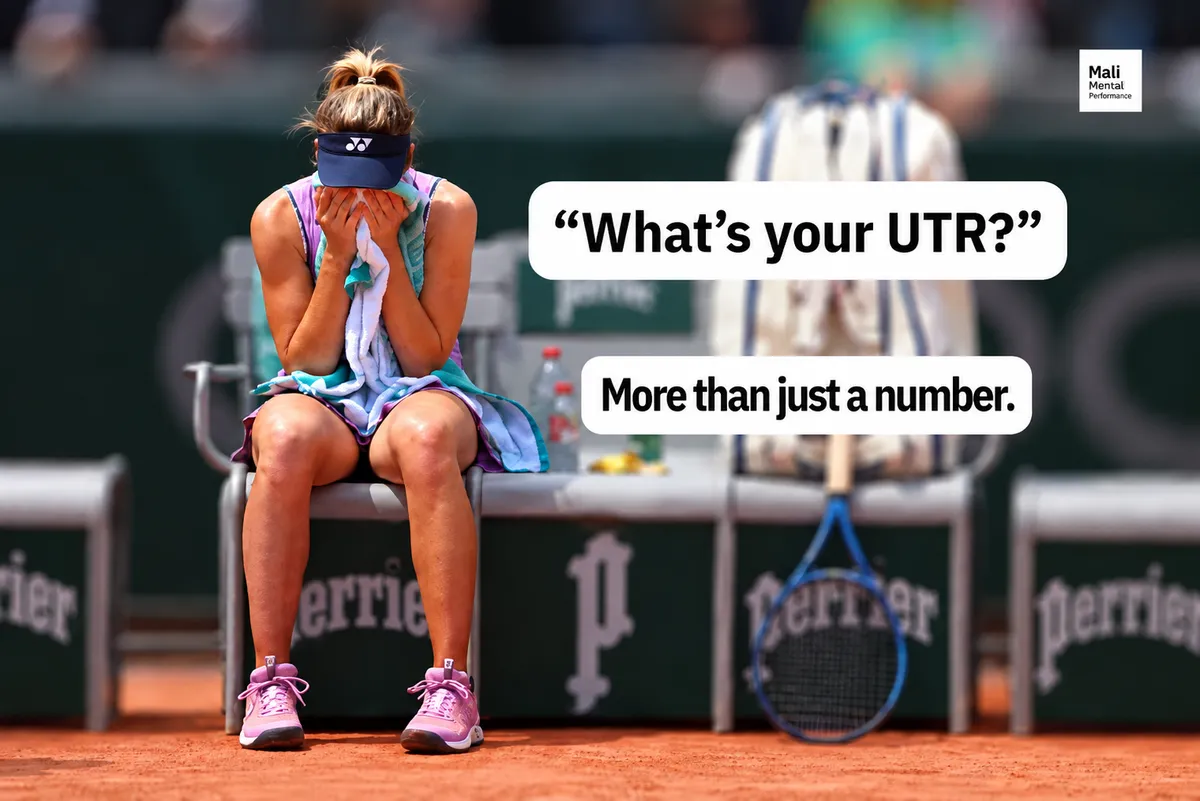
The problem with UTR
“What’s your UTR?”
It’s a common question heard around the world.
Junior players ask it of one another.
Adult players eagerly or with trepidation refresh their webpage to see the impacts of the latest win or loss.
Worse, parents of tennis players obsess and fret over it. They debate and joust with other tennis parents about their child’s UTR, what someone else’s UTR should really be, and, usually, how their child’s UTR is lower than it really should be.
This algorithmic rating has captured the minds and motivations of the tennis world.
I’ve worked for UTR as a writer, and initially, I was quite supportive of it. But over time, as I saw the ripple effects in junior development, the world of aspiring tennis professionals, and even in adult leagues, I started to pause.
Is it really a good thing to reduce how we see a player to a single number down to two decimal points? One that’s publicly available for teenagers to obsess over? One that can influence tournament choices, recruiting conversations, and even self-worth?
The more I’ve studied sport psychology research and advanced further down this path, the more I’m unsure.
UTR can be a helpful tool. But unless players, parents, and coaches really know how to interact with it and treat it for what it is—just a tool—I can see it continuing to cause havoc in the lives of the uninformed.
So I want to cover how this UTR obsession interplays with three areas of sport psychology research, all of which overlap with one another:
Ego-orientation vs. mastery-orientation.
Intrinsic vs. extrinsic motivation.
Outcome vs. process goals.
Ego-orientation vs. mastery-orientation
What do you tie your self-worth to? When players link it closely to outcomes—like ratings, rankings, and results—they can become fixated on comparison. What is my UTR? Did it jump up 0.3 or fall by 0.2? It’s like a stock you’ve invested in and with each adjustment, you’re experiencing the emotional effects of losing or gaining thousands and thousands of dollars. Elation. Then despair.
Is this familiar to you? With an ego-orientation, success is defined by outperforming someone else. Failure? Well… that’s when you fall short in the comparison.
Because ratings are public, comparison can become the default. If we think about how anxiety can shift our focus toward threat-related stimuli in our environment—see Attentional Control Theory, Eysenck et al. (2007)—we can see how being obsessed with UTRs can interfere with our ability to stay focused on execution. Instead, your attention is continually brought back to the effects of the win or the loss.
If I lose to this player, then my UTR will go down. I can’t have that. That would be terrible.
It’s really hard to perform well if your thoughts are hijacked with content like this.
What’s the alternative?
A mastery orientation. Success is defined here as personal improvement and achievement. Failures are not a reflection of your worth in relation to others or a rating. They are just a reflection of where your skills are at the moment.
Players with a mastery focus care more about how well they’re executing skills, patterns, tactics, and their mental approach—regardless of the UTR of the player across the net. Success is defined internally, and it’s not based on external metrics.
Athletes who build a mastery orientation around their game and see it as a long-term project of skill development tend to experience greater resilience, lower competitive anxiety, and higher intrinsic motivation.
Which leads us to the next section. Notice how these concepts are interrelated.
Intrinsic vs. extrinsic motivation
UTR obsession has a way of pulling players into chasing extrinsic rewards.
Extrinsic rewards exist outside of you: a ranking, a rating, a scholarship, or the approval of your coaches, parents, and peers. Perhaps you dream about getting to the courts one day and having your peers fawn over your UTR. Oh my god, did you see their UTR and how it went up?
Be honest. Has this been you? I’ll be honest. It has been me.
And to be fair, external motivation isn’t all bad. It can get us out of bed early, push us through tough conditioning sessions and rough times. But when extrinsic motivation becomes your sole focus or the only thing you care about—I need to get my UTR to 12.5—you can start to experience a few problems.
If extrinsic rewards are the only things that drive you, then what happens the moment the rewards dry up? What happens when your UTR is no longer improving or, worse, if it starts to fall? Will you really take the time to fix your shitty serve which you can’t hit above 100 mph if that means your UTR will fall a full point? Will you really experiment with that new pattern of play if you’re worried about the immediate impacts on your UTR?
Let’s flip it. If you’re a player with strong intrinsic motivation, your focus is on the enjoyment you derive from the game, the challenge of mastery, and the rewards of internal growth. You are more likely to persist through adversity, bounce back from failure, and sustain long-term development.
Maybe you didn’t start with this approach in mind, but if you find yourself reflecting that you’ve been hijacked by UTR obsession, I want you to know that you’re working on extremely shaky foundations. But if you’re playing because you love improving, adding skills to your repertoire, and improving your competitive skills and emotional resilience, you’re on much more solid ground.
UTR is not necessarily the villain here. It’s just a tool. But if you give it the steering wheel and let it hijack your motivation… you’re going to struggle.
Outcome vs. process goals
The research gives us good reason to emphasize process goals for improving performance (Williamson et al., 2022). But a lot of players set goals like, “I want to get my UTR to 12 by the end of the year.” There’s nothing wrong with setting this outcome goal, but players often skip the most important part: setting the process, performance, and mastery goals that will get us to that outcome.
If the only thing you’re measuring yourself by is your outcome goals, it’s easy to spiral into frustration when things don’t go to plan. What if the only goal you set was to improve your UTR by 2 points in a year and you don’t achieve it? How will you feel?
Instead, emphasize process goals for performance and mastery goals for long-term development.
Process goals
Process goals are actions and intentions you have a high degree of control over. Things like:
I will be brave and approach the net every time the ball lands short.
I will maintain my routines between every point.
I will follow my breathing routine each time I serve.
Mastery goals
Mastery goals relate to the long-term development of your skills. Things like:
I need to add 20 mph to both my first serve and second serve.
I need to improve my overall speed and explosiveness.
I need to clean up my volleys so that I feel more comfortable approaching and closing out at the net.
Mastery goals should further be broken down into process goals for practice so that you can actually target the skills you want to improve.
Your takeaway
If you only set UTR-based goals, you’re setting yourself up for an emotional roller coaster. Wins mean ecstasy and losses mean deep moments of sadness or upset. But if you understand the impacts of having an ego orientation vs. mastery orientation, are aware of whether you’re intrinsically or extrinsically motivated, and know how to set appropriate process and mastery goals for long-term development, you’re more likely to share a healthier relationship with the sport.
Now here’s the problem: you may intellectually understand all of this—even if you still struggle with a severe ego-orientation. Since there is an experiential component to belief change, simply having this information is not enough. You need to apply and interact with it. A sport psychology professional can help you examine your beliefs, test them, and practice a different approach.
References
Eysenck, M. W., Derakshan, N., Santos, R., & Calvo, M. G. (2007). Anxiety and cognitive performance: Attentional control theory. Emotion, 7(2), 336–353. https://doi.org/10.1037/1528-3542.7.2.336
Williamson, O., Swann, C., Bennett, K. J. M., Bird, M. D., Goddard, S. G., Schweickle, M. J., & Jackman, P. C. (2024). The performance and psychological effects of goal setting in sport: A systematic review and meta-analysis. International Review of Sport and Exercise Psychology, 17(2), 1050–1078. https://doi.org/10.1080/1750984X.2022.2116723